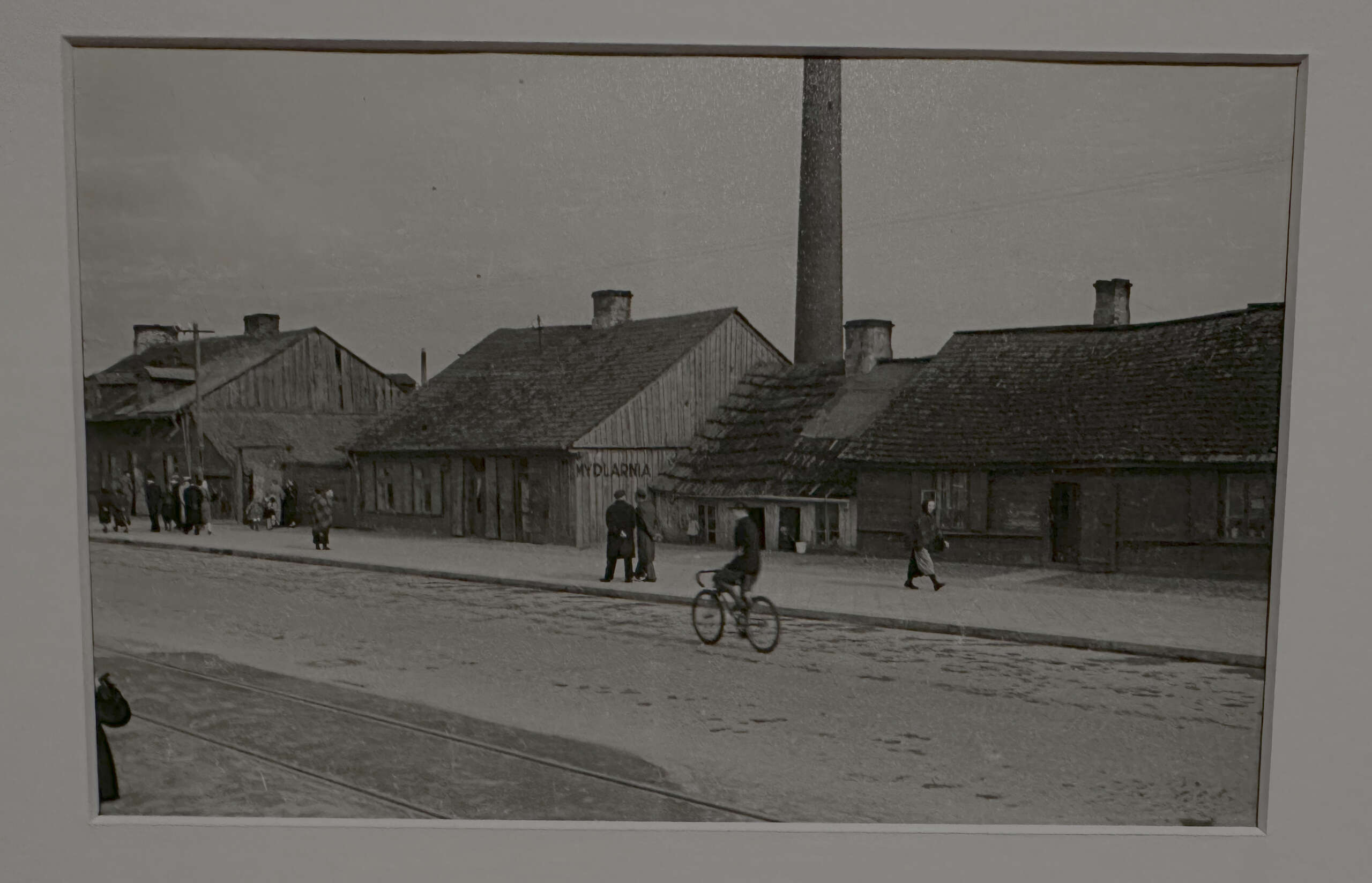
In 1936, a photographer stood on Wolska Street in Warsaw and pressed the shutter. The frame caught three things: a boy on a bicycle, a row of modest wooden tenements, and the painted sign MYDLARNIA — a small soap manufactory — set between two low houses with a factory chimney rising behind them.
The boy, probably eleven, pedals across the frame on a bicycle a little too large for him. His legs reach the bottom of the pedal stroke only when he stands. His back is straight. He is moving west, away from the city centre, past buildings that have perhaps thirty-six months left before they are gone forever.
What the Photograph Shows
The address, recorded in the Muzeum Warszawy exhibition caption, is Wolska 185, 187 and 189. The buildings stand on the far western fringe of what was then a working-class district, Wola, home to small-scale manufacturing, Jewish artisans, and tram lines carrying workers to the city’s factories. The soap factory in the frame — the mydlarnia — is a reminder that Warsaw before the war was a city of countless small enterprises, each occupying a single room or shopfront, each serving a few streets.
The buildings themselves are poorer than they appear in reproduction. One sits below the level of the street — the exhibition note is specific on this point — a sign that the land had been built upon in haste, without the drainage and grading that a proper city plan would require. The wooden walls will not survive the first winter of the Siege. The chimney will fall. The soap factory will not be rebuilt.
The Boy on the Bicycle
No one knows who he was. The photograph does not record his name. He is not the subject — the subject is the architecture, documented for reasons we can only guess at. Perhaps the photographer was commissioned by the city to document a district slated for redevelopment. Perhaps he was simply walking with a camera and the boy on the bicycle happened into the frame.
But without the boy, the photograph would be real estate. With the boy, it becomes an account of a place where someone was living, where a child could ride a bicycle to the end of a particular street and back, where the morning smelled of soap being boiled. The bicycle is almost incidental — a vehicle, nothing more — and yet it transforms the image. Without the figure in motion, the frame is a document. With the figure in motion, the frame is a memory.
The Afterlife of a Negative
What survives from this photograph is not the original print, but a gelatin silver print made around 1970, from the original negative, by the Muzeum Warszawy photographic archive. The reproduction — registered under catalogue number AF 42057 — was prepared decades after the original was taken, in a Warsaw that no longer resembled the one in the frame. The soap factory had been rubble for a quarter century. The wooden tenements existed only in the archive.
This is the standard afterlife of pre-war Warsaw photographs. The negatives were kept — sometimes by accident, sometimes by small acts of civic bravery during the Occupation — and the prints that we see today are reproductions, often several generations removed from the moment of exposure. Each print is a translation. Each print loses something. Each print adds the thumbprint of the technician who made it. We are looking at a photograph of a photograph of a street that is gone.
Bicycles in Pre-War Warsaw
The bicycle in 1936 Warsaw was still a modestly aspirational object. Private cars were rare, limited mostly to the upper middle class. Trams were the dominant form of public transport. The bicycle sat between the two: too expensive for the poorest residents, affordable for a skilled worker or a shop-owner’s family. It was a vehicle for errands, for short commutes, for a child’s independence on a sunny afternoon.
By the mid-1930s, cycling clubs had been active in Warsaw for nearly fifty years, and bicycle racing was a popular spectator sport at the Dynasy velodrome. The city’s streets, mostly cobbled, were not kind to tyres. But the bicycle persisted because it did what nothing else did — it put a person in motion on a scale of distance that neither feet nor trams could match. For a boy on Wolska Street, the bicycle was the first means of leaving home and returning on his own terms.
The Caption, the Print, the Trace
The exhibition caption at Muzeum Warszawy pairs this image with a second photograph of the same wooden buildings, taken from a different angle, also around 1936. The two prints are deliberately installed side by side — a reminder that documentation of this district was serious work, carried out methodically, before the sudden and total loss of the subject.
Looking at the image today, in a Warsaw where Wolska Street is lined with glass office buildings and the former soap factory site is covered by a residential block built in the 2010s, we see a photograph that does more than record. It accuses. It implies a question. What have we chosen to keep and what have we agreed to lose? The boy on the bicycle, moving across the frame on his too-large machine, is already answering: the people were the city, and most of them — and most of their houses — are not here anymore.
Photograph: “Cyclist and pedestrians on Wolska Street”, c. 1936. Gelatin silver print, c. 1970. Collection of Muzeum Warszawy (AF 42057). Documented in the exhibition “Aleksander Minorski. Fotografia to interwencja”, Muzeum Warszawy (Rynek Starego Miasta 32), 18 March – 6 September 2026. Curated by Karolina Puchała-Rojek.