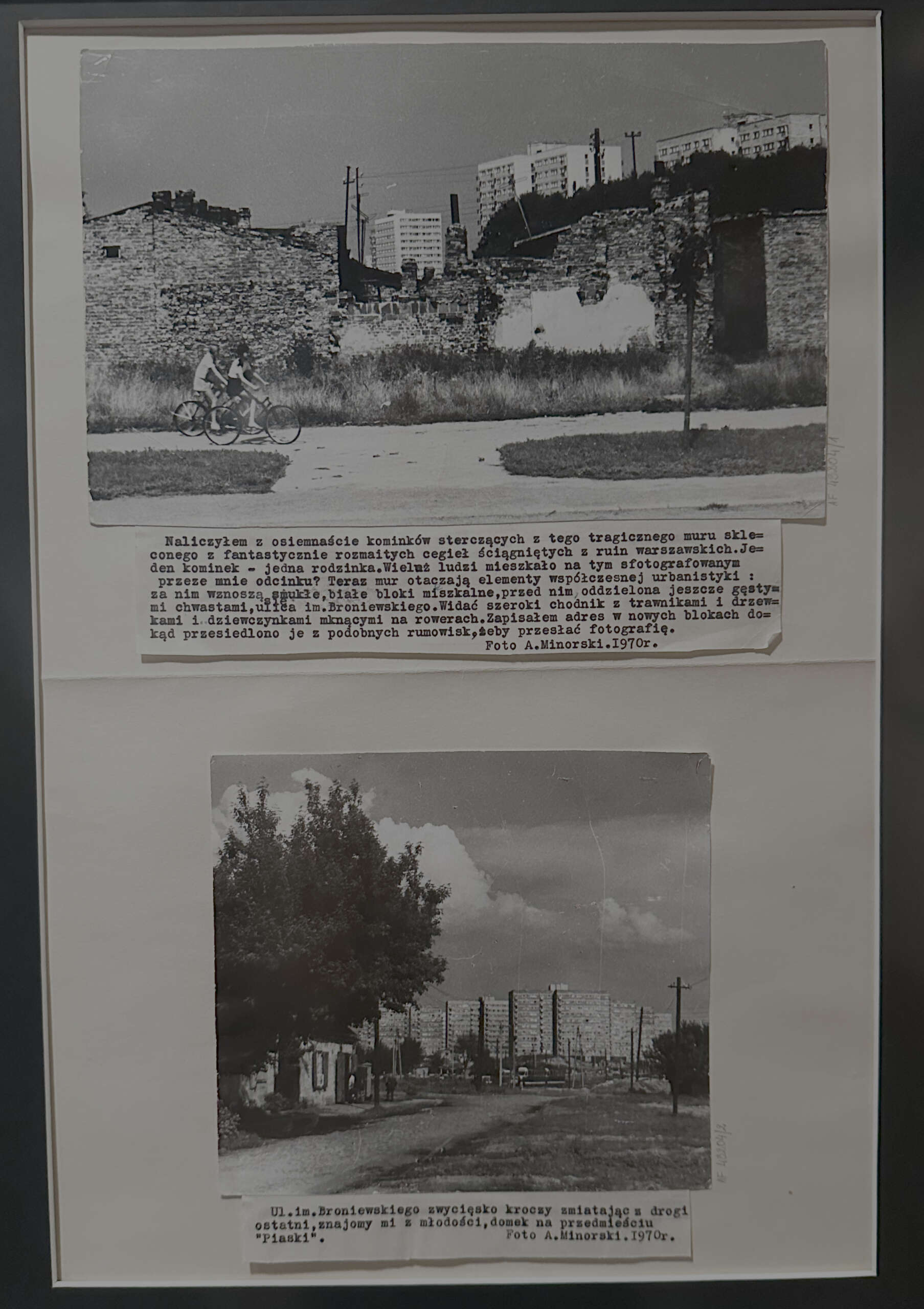
There is a photograph taken in Warsaw in the summer of 1970 by Aleksander Minorski, and beneath it, pressed in the artist’s own typewriter, a passage that reads more like elegy than caption. “I counted eighteen chimneys jutting from this tragic wall, cobbled together from the fantastically varied bricks pulled from Warsaw’s ruins,” Minorski writes. “One chimney — one little family. How many people lived on this stretch I photographed?”
The image itself seems ordinary. Two girls on bicycles glide along a wide pavement bordered by weeds. Behind them rises a crumbling brick wall, scarred, patched, impossible. Behind the wall, pristine white housing blocks reach into the Warsaw sky. The street has a new name — Broniewski — and a future that erases its past, except for this stubborn relic the municipal planners did not quite finish demolishing.
Minorski the Chronicler
Aleksander Minorski (1908–2003) spent six decades walking Warsaw with a camera. His biography reads less like an artist’s résumé and more like a social worker’s field notes. He photographed the pre-war Jewish quarter and returned, three decades later, to the same streets reduced to foundations. He documented workers’ districts, May Day parades, ordinary citizens going about ordinary business in a city that would not stop reinventing itself.
In 2026, Muzeum Warszawy opened the first monographic retrospective of his work, Aleksander Minorski. Fotografia to interwencja (Photography is an Intervention), curated by Karolina Puchała-Rojek. Nearly 300 objects — prints, films, and the artist’s own typewritten commentary — traced a photographer who understood images as civic acts. The exhibition closed on 6 September 2026. These notes are made in its memory.
The Chimneys of Broniewski Street
The 1970 series on Wrząca Górka — a demolished working-class settlement on the edge of Żoliborz — is perhaps the most moving work in the show. Minorski photographs what remains: a long brick wall that was once the back of a row of houses. Eighteen chimneys still rise from it, each one marking a hearth that is gone.
The counting is important. Minorski does not stop at the aesthetic appeal of a ruin. He counts. He asks who lived there. He notes, in his typescript, that he recorded the forwarding address of the little girls on bicycles — residents newly relocated to one of the smooth white blocks in the frame — so he could send them a copy of the photograph. The gesture turns the image from documentation into correspondence. The ruin is not a backdrop for aesthetic contemplation. It is a letter addressed to the people who used to live there.
Bicycles as Connective Tissue
What role does the bicycle play in this frame? It is not the subject. The subject is the wall, the chimneys, the vanishing settlement. But the bicycles are what carry the eye through the composition, what give the scene its temporal signature. The girls are moving. They are late-childhood, probably ten or eleven, already competent cyclists, already accustomed to the geography of the new estate. They move in the present tense across a frame that is otherwise a ruin.
Across Minorski’s work, the bicycle recurs as this kind of connective tissue. It belongs to the people who live in the city, not to the architecture that houses them. When the architecture changes — when the wooden houses are replaced by panel blocks, when neighbourhoods are flattened and relabelled — the bicycle persists as an unbroken thread. A boy on a bicycle in 1936 on Wolska Street. A pair of lovers with their bicycles in 1970 overlooking Szczęśliwice housing. Children on bicycles in the summer of 1970 on Broniewski Street. The frame changes. The vehicle does not.
This is, perhaps, part of what makes bicycles so compelling to photographers of the city. The bicycle is portable, intimate, personal. It cannot be a monument. It cannot be a façade. It belongs to a body, to a specific moment, to a journey that will end before the shutter’s next click. In a photograph of urban change, the bicycle is the thing that reminds the viewer that cities are, above all, made of people in motion.
The Second Photograph: a Last House
In the same frame, below the chimneys, Minorski places a second image. A single small house, surrounded by weeds, with the apartment blocks of the Sady Żoliborskie II estate rising behind it. His caption: “Broniewski Street victoriously advances, sweeping from its path the last little house I know from my youth, on the outskirts, in Piaski.”
“Victoriously” is a word carrying great weight here. There is no triumph in Minorski’s voice. There is a weary acknowledgement that this is how cities expand — by erasure — and that the erasure is sometimes the correct choice, sometimes merely the convenient one, and almost always a kind of loss. The small house on the edge of Piaski was known to the photographer in his childhood. He is now sixty-two. The next time he returns, the house will be gone.
What the Archive Keeps
The prints survive in the Archiwum Fotograficzne Muzeum Warszawy under catalogue number AF 43204/1-2. They are gelatin silver prints on paper, with the artist’s original annotations pasted below each image. The pairing is deliberate. One photograph alone would be documentation. Two photographs with Minorski’s commentary become a text, a position, a quiet civic argument.
The children on bicycles never saw their photograph. Minorski recorded the address, and whether the envelope was ever posted the record does not say. But the image reached us anyway, half a century later, in a Warsaw museum, on a wall where a visitor could stop and read the typewritten paragraph and look again at the smooth white blocks and the stubborn brick wall and understand that the two things in the frame — past and future — have never actually been resolved.
Photographs: Aleksander Minorski, Wrząca Górka, 1970. Collection of Muzeum Warszawy (AF 43204/1-2). Documented in the exhibition “Aleksander Minorski. Fotografia to interwencja”, Muzeum Warszawy (Rynek Starego Miasta 32), 18 March – 6 September 2026. Curated by Karolina Puchała-Rojek.