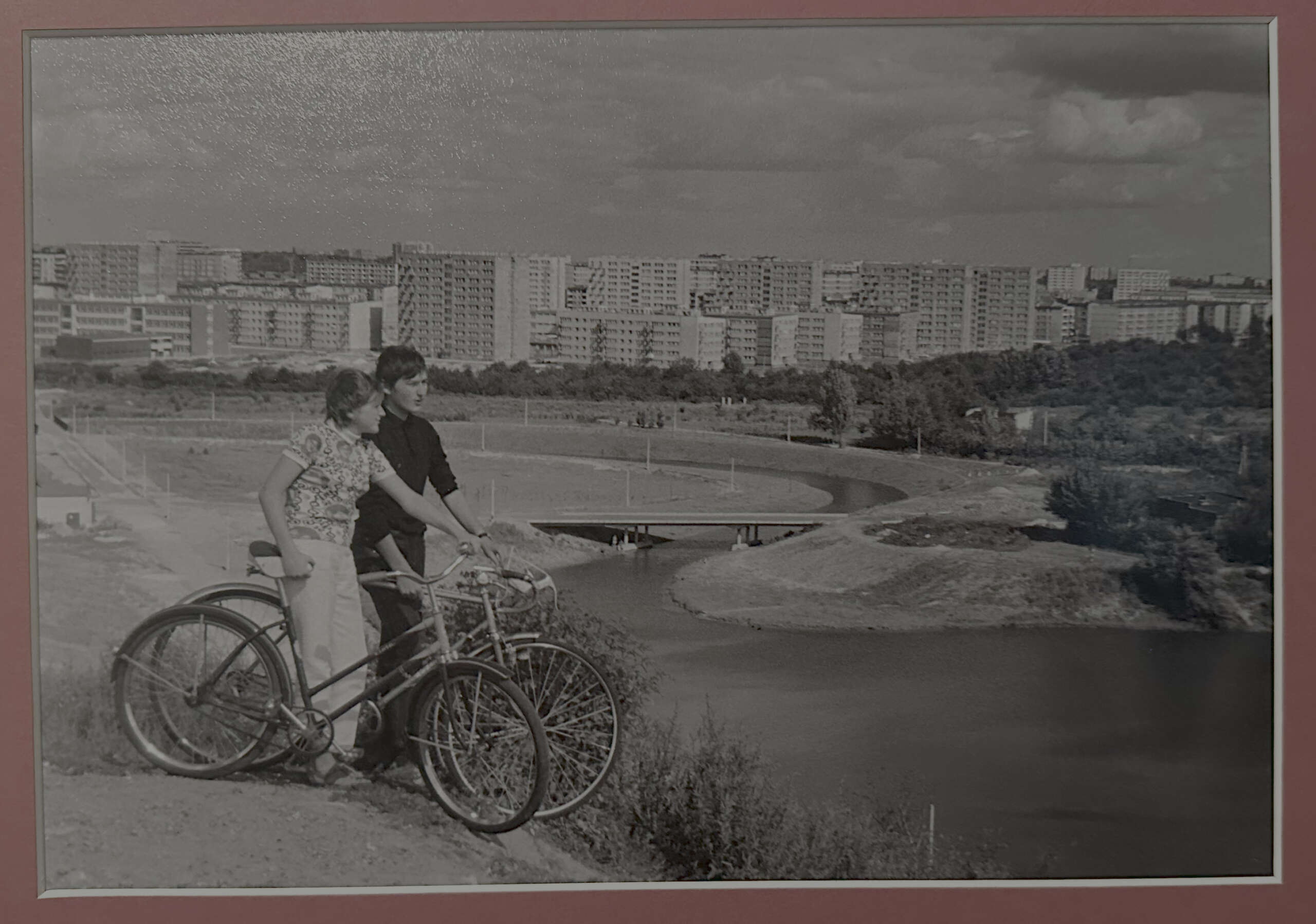
At the top of Szczęśliwice Hill, in the summer of 1970, a young man and a young woman stood with their bicycles. The woman wore a patterned blouse and white trousers, her hair cut just below the ears. The man wore a dark shirt, open at the throat, the sleeves rolled to the elbow. Their bicycles — two Polish city machines of the Romet or Jubilat generation — leaned on their frames behind them, wheels still, pedals at rest. Below them, a river curved, a bridge crossed it, and beyond the river, perfectly aligned on the horizon, the housing estates of Ochota rose in orderly ranks.
Aleksander Minorski made the photograph. It was one of hundreds he took that decade, documenting the rapid construction of new Warsaw — new in both the municipal and the demographic sense — and it survives today in the collections of Muzeum Warszawy under catalogue number AN 105493/3.
What the Hill Was
Szczęśliwice Hill is one of the strangest landmarks in Warsaw. It is not a natural hill. It was made in the post-war decades from the city’s debris — brick dust, rubble, broken plaster, concrete fragments, everything that could not be reused in the Reconstruction. The debris was piled, flattened, planted with grass, and gradually accepted as a hill. By 1970, when Minorski climbed it with his camera, it already looked permanent.
This is a hill that is also an archive. Every cubic metre of its mass is a cubic metre of what Warsaw used to be. Walking to its summit is a form of time travel into the material memory of the city. The young couple in the photograph may not know this, or may know it perfectly well — the hill’s origin was common knowledge among Warsaw residents of their generation — and they stand on it with their bicycles the way one stands at a scenic viewpoint, taking in a view that promises both the future and a kind of settled peace.
The Housing Estate Beyond
The buildings on the horizon are the beginnings of what would become the Szczęśliwice housing estate — developed along the streets of Urbanistów, Władysława Korotyńskiego and Geodetów, as the exhibition caption at Muzeum Warszawy records. These are late-modernist buildings, large-panel prefabrication, five to eleven storeys. They look, in the photograph, both immense and provisional — as if they had been assembled quickly and might be dismantled just as quickly.
For the two young people on the hill, this is not an abstraction. One or both of them probably lives there, or will soon. The housing was intended for the first generation of post-war university graduates, young engineers and clerks who had grown up in cramped apartments and were being offered, by the state, their first set of walls that belonged entirely to them. The composition of the photograph — two cyclists in the foreground, apartment blocks in the background — is also an economic diagram. The bicycles are what connect the young couple to the city. The flats are what connect them to the state.
Minorski Looking Back
By 1970, Minorski had been photographing Warsaw for more than four decades. He had documented the pre-war Jewish quarter, the Occupation, the Reconstruction, the May Day parades, the demolition of wooden Wola, the raising of the first panel blocks. He was, by this point, an old-fashioned photographer in a very contemporary sense — he believed that photographs were a form of civic obligation, that the camera recorded what the city would otherwise forget.
The Szczęśliwice photograph is quieter than most of his work. There is no social commentary explicit in the frame. The young couple are not working, not demonstrating, not in poverty. They are, by the standards of 1970 Warsaw, modestly prosperous. They have bicycles, holiday time, a view. The photograph is, in Minorski’s typical mode, a document of a moment when the city and the people in it were briefly in alignment.
The Bicycles
What are the bicycles doing in the frame? Carrying their riders to the summit, obviously. But also fixing the picture in a particular social class, a particular leisure practice, a particular relationship to the city. In 1970 Warsaw, a bicycle was not a luxury, but neither was it a necessity. A couple who climbed Szczęśliwice Hill with bicycles were a couple who had chosen that mode of travel — who had spent the sixty złoty for a decent used Romet, who had planned the ride, who understood the hill as a destination worth cycling to.
Their bicycles are not sport machines. They are standard city frames with mudguards, chainguards and upright handlebars — the practical and faintly utilitarian design of the Polish bicycle industry in its mid-century phase. They are the bicycles that belonged to a specific time and have very nearly stopped being made. If the couple have kept their machines, which is improbable, those bicycles are now in attics or basements, or more likely were given away to a nephew in the 1990s and are long since dismantled for parts.
A Photograph That Keeps a Promise
The image is a quiet photograph. It is not iconic. It will not appear on the cover of a book. It survives because the Muzeum Warszawy archive is thorough, because Minorski was systematic, and because the exhibition Fotografia to interwencja placed it on a wall in a red passepartout with a careful typographic label. Fifty-six years after it was taken, it still shows two young people with bicycles on a hill, and it still says what a photograph can say: here were people, here was a city, here was a particular afternoon in the summer of 1970.
Photograph: Aleksander Minorski, “Two Cyclists at the Top of Szczęśliwice Hill”, c. 1970. Contemporary inkjet print from the 24 × 36 mm negative scan. Collection of Muzeum Warszawy (AN 105493/3). Documented in the exhibition “Aleksander Minorski. Fotografia to interwencja”, Muzeum Warszawy (Rynek Starego Miasta 32), 18 March – 6 September 2026. Curated by Karolina Puchała-Rojek.